Five Cats and Five Movements and Ancient Kemmet
Updated: Dec 26, 2025
Five Cats and Five Movements is back on track for publication. I'd hoped to publish the eBook in November, but finalizing the final draft took more work than expected. I hope to get the eBook out next week and begin a serious marketing effort for both it and the Last Shadow. As an "appetizer" for Five Cats and Five Movements, the following background research is served.
Notes on Kemmet and Kemmetic Characters
Five Cats and Five Movements draws heavily from ancient Kemmet, which is more popularly known as ancient Egypt. I've always believed that "Kemmet" should be translated as "The Black Nation." The hieroglyph for the word included the symbol that was used for any town, city, or nation-state. This symbol consisted of a crossroad surrounded by a circular wall, and it was the non-vocalized part of the word. The glyph also included a piece of charred wood (i.e., coal), which was the symbol for the color black. This symbol was pronounced as “km.” Two other symbols were also included: an owl for “m” and a bread loaf for “t." This left the following for vocalization: "Km" (black) + "m" + "t" = ” Kmmt" or "Kemmet."
Contrary to other assertions, there is nothing in the hieroglyph for “Kemmet” that corresponds to “black soil,” “black landscape,” or “black land area.” The word for these features was usually “ta,” which was part of lesser used names for the country, such as Tawy (The Two Lands, i.e., Upper and Lower Kemmet), Ta-Seti (Nubia), and Tameri (The Beloved Land). It should be further noted that the soil around the Nile is closer to a reddish-brown, as it is at the Nile’s primary source in Ethiopia.
In speaking, the nation was called something tantamount to "Blackness" due to the non-vocalized part of the word. The “t” consonant was used to give it a feminine quality. (I've added "ness" to give it the same feminine sense.) This practice was much the same as is done today when people view a country as their “motherland.” It is also worth noting that “k” only approximates the sound that the people of Kemmet used with this word. Other approximations, such as “kh” and “h” have also been used, which translates “Km,” “Khm,” and “Hm” into different versions of the same word, i.e., Kem, Kam, Khem, Kham, and Ham.
The various sects of Kemmet called the forces of earth and sky "neteru" and personified them metaphorically as gods. (I dislike the term “religion” since the Kemmetic scribes did not separate spirituality from science.) The word “neter” is usually pronounced as “neh-turr” in accordance with American standards. International pronunciations translate it more as “nay-churr” where “t” is often pronounced “ch.” Ironically, the “ch” sound corresponds with the American and British pronunciations of “nature,” which I believe refers to the same primeval forces as “netcher.” I therefore use them interchangeably. However, for dramatic purposes, the neteru are presented in this story as superhumans who have mastery over forces of nature, instead of as the forces themselves.
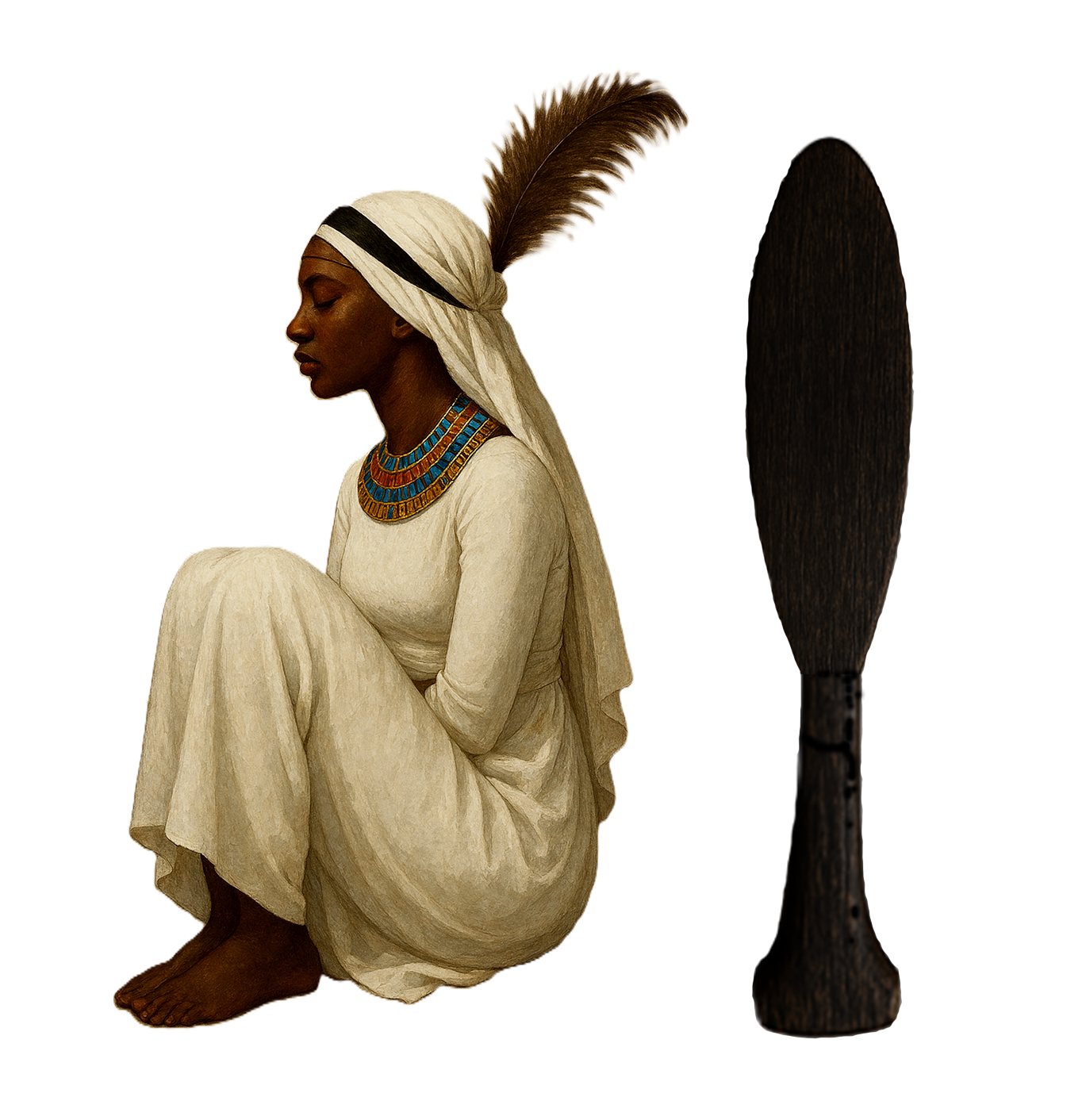
According to ancient Kemmetic texts, the home of these neteru was Punt, which is widely recognized as modern-day Somalia. Therefore, the neteru in this story are described with features that are typical for residents of the Horn of Africa and the Sub-Saharan Nile Valley. Below are hairstyles worn by Kemmetic royalty that influenced the depictions of neteru in this novel. (Top left to right bottom are Princess Kiya, Queen Tiye, King Amenemhet III, Queen Nefertiti, and Khereduankh - Mother of Imhotep. Bottom center are wigs worn by Kemmetic royalty.) The final four pictures show how modern East Africans have maintained this aesthetic.


I interpret the main neteru characters as human “netchers,” i.e., beings who exemplify various human “natures”: Violent (Sekhmet), Humane (Wasr), Clever (Wasṭ), Brutal (Set), Hedonic (Nebṭ-Heṭ), Inquisitive (Chehuti), and so on. These qualities varied, depending on interpretations by different Kemmetic sects.
My interpretations draw from various Kemmetic texts, such as The Destruction of Mankind in which Ra, Sekhmet, and Heṭ-Her (Hathor) are the main characters. Another influence was the Contentions of Heru and Set, where these two netchers battle for the throne of Kemmet. Wasr (Osiris/Ausar), Wasṭ (Isis/Auset), and Nebṭ-Heṭ (Nephthys) also feature prominently in this tale. (I consider Nebṭ-Heṭ to be the human aspect of Heṭ-Her.) In a third inspirational story, Wasṭ steals the power of Amen-Ra by tricking him into revealing his true name.
To learn more about Kemmet and the netcheru, I encourage you to read Anthony T. Browder’s Nile Valley Contributions to Civilization, Miriam Lichtheim’s Ancient Egyptian Literature, E.A. Wallis Budge’s The Book of The Dead: The Papyrus of Ani, and Stephen Quirke’s Ancient Egyptian Religion.


Comments